Induced Helical Polymer project
Computational Scientist, Chemistry (2017-2022)
Institute of Nanotechnology, Karlsruhe Institute of Technology (Germany)
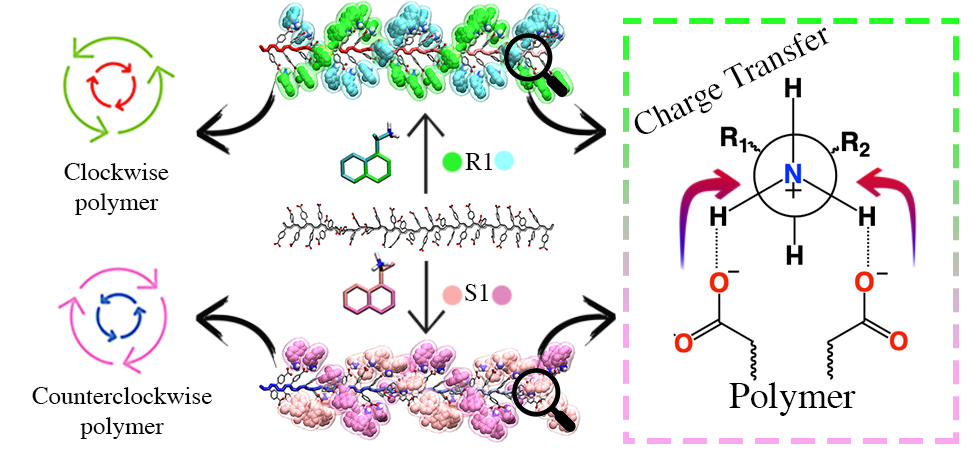
Dynamic helical polymers have been widely experimentally studied. However, experimental techniques struggle to determine the mechanisms and principles responsible for helix formation. Helical sense can be induced in dynamic helical polymers such as *cis-transoid* poly 4-(carboxyphenyl) acetylene (poly-1) by interacting with chiral amines and the mechanism of helical induction process is not understood.
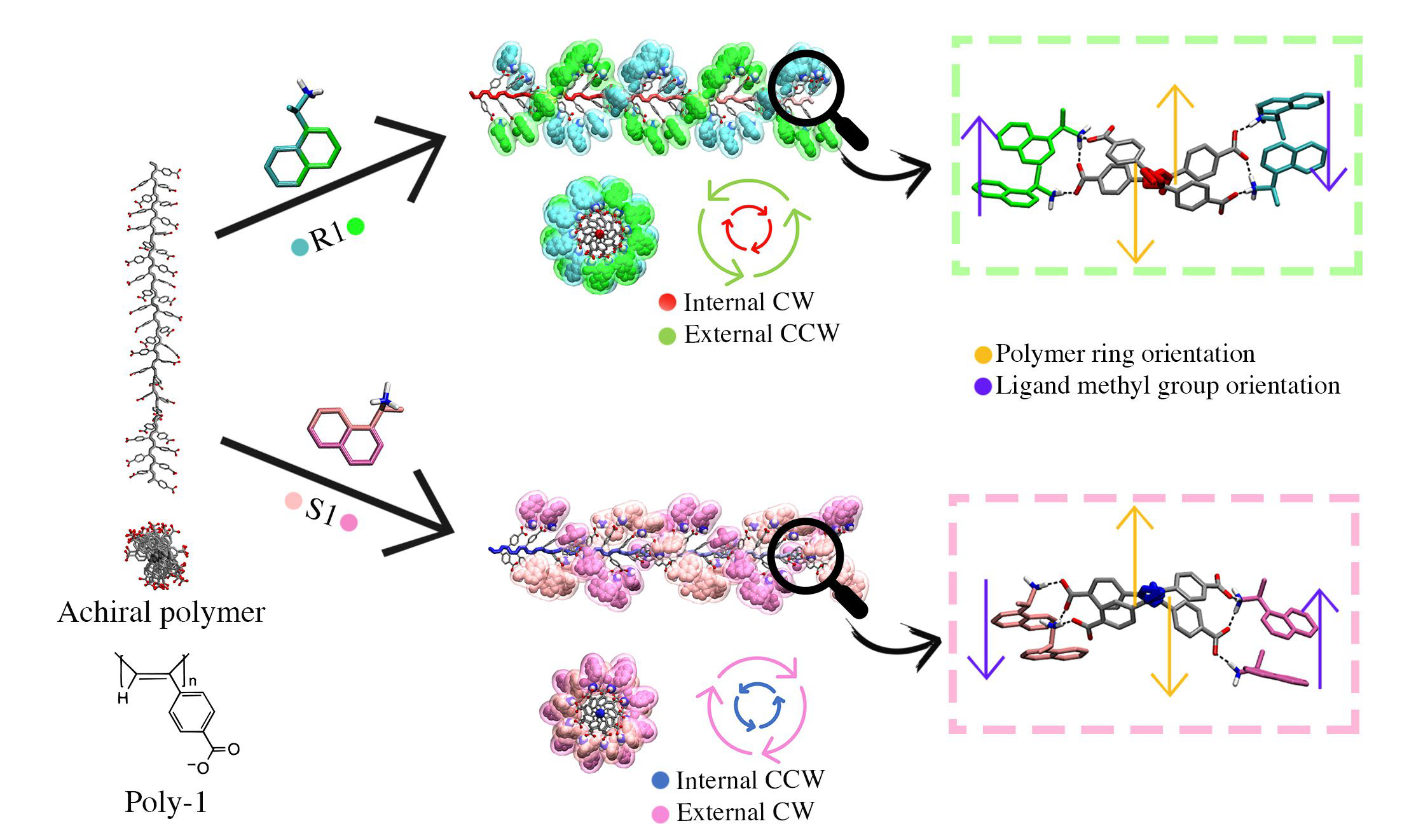
In this work I studied the helical induction process of poly-1 interacting with (R)- and (S)-1-(1naphthyl)ethylamine (R1 and S1), which is an important reference system. Combining computational Molecular Dynamics (MD) and Density Functional Theory (DFT) approaches, I tested the flexibility of the polymer helical models and the interactions of polymer-amine complexes.
In our publication in the *ACS Journal of Chemical Information and Modeling* we were able to explain the stabilization of the complexes polymer-amine using DFT calculations in 4 monomer polymer-amine complexes and using Bader charge analysis. We reproduced affinity trends calculating the dissociation energies of chiral amine molecules with poly-1 in agreement with experiment. Our results showed that there is a clear trend in the affinity of R1 and S1 for the clockwise and counterclockwise screw-sense of poly-1, respectively. This result is supported by the structural analysis of the complexes and the different local electronic effects in the interaction polymer-amine.